
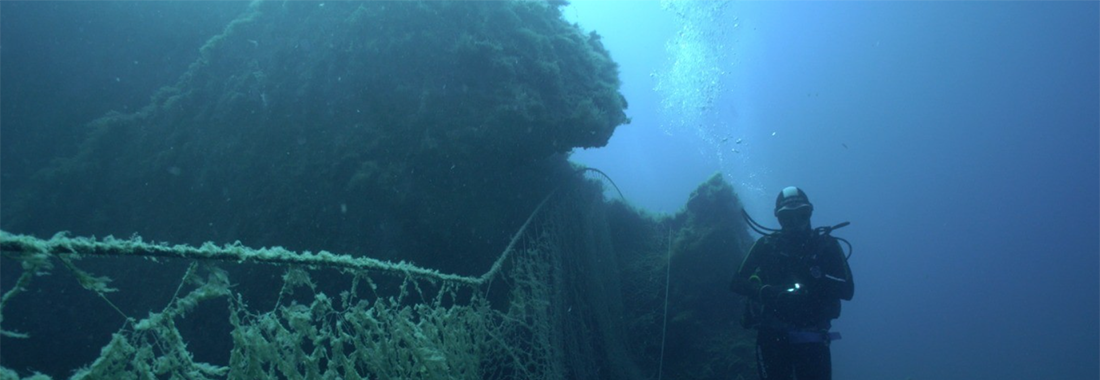
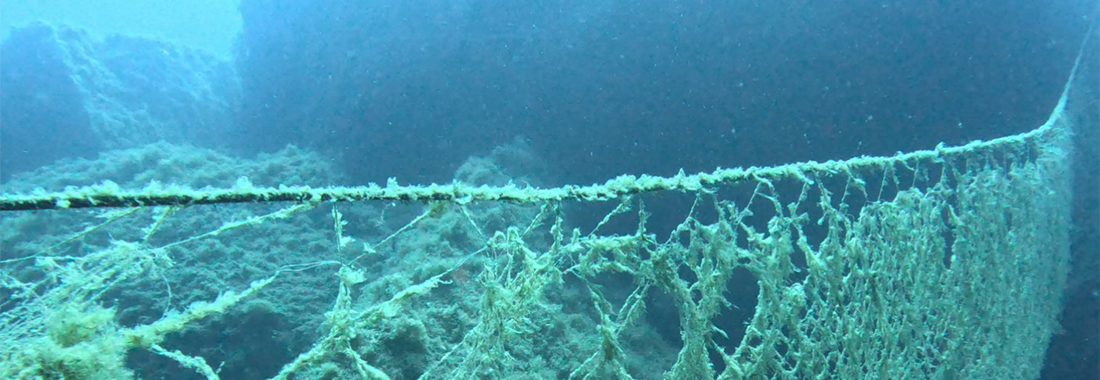
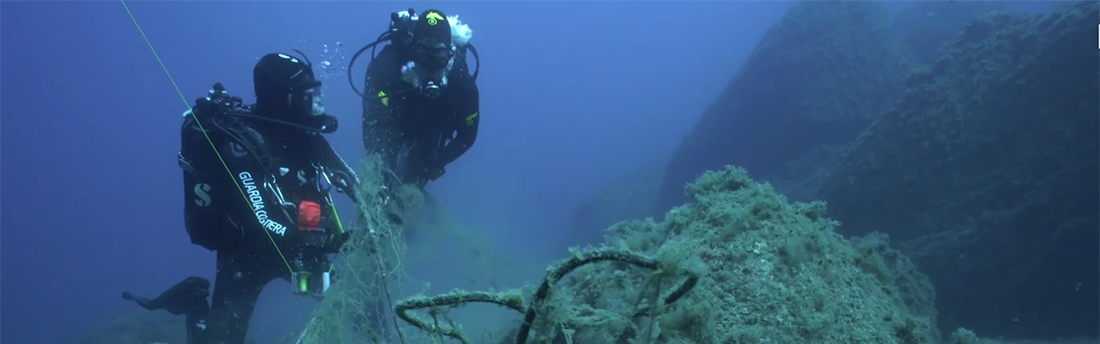
120 kg of fishing nets were removed from the seabed, while a further 510 kg of nets and other fishing gear recovered during previous operations were disposed of, together with 60 kg of waste collected from Porto Giunco beach.
This is the result of GhostNetBusters – Hunting Ghost Nets – an initiative aimed at recovering abandoned fishing gear from the waters of the Capo Carbonara Marine Protected Area.
Two long abandoned fishing nets, measuring more than 120 metres in total, were lying on the seabed at one of the most beautiful diving sites in the Capo Carbonara MPA. The nets had been identified and reported in recent months by local diving operators and were recovered on 4 September by a specialised team made up of the 4th Underwater Unit of the Cagliari Coast Guard and the Carabinieri Diving Unit, as part of the GhostNetBusters operation.
At the same time, a clean-up activity took place on Porto Giunco beach, coordinated by MEDSEA together with the Diomedea Cooperative and supported logistically by the Forestry and Environmental Surveillance Corps. Around twenty citizens and volunteers gathered at 9 a.m. in Piazzetta della Marina in Villasimius and cleaned several areas around Porto Giunco beach and the nearby Notteri lagoon.
In the early afternoon, the net recovered that morning became the focus of a workshop on ghost fishing, held at the Primo Molo restaurant, home of the Villasimius branch of the Italian Naval League. The session offered an opportunity to raise awareness and explore the impact of abandoned fishing gear on marine ecosystems and on wildlife that can become trapped in it, as well as the strategies available to prevent fishing gear from being lost at sea.
The initiative was also made possible thanks to the support of Patagonia, which has a long-standing commitment to protecting marine and coastal environments through its environmental grants programme. Through GhostNetBusters, Patagonia continues to support local organisations working directly in the field to protect ocean health, backing an initiative that combines the physical removal of marine litter, community engagement and scientific outreach.
The action was organised by the MEDSEA Foundation in collaboration with the Capo Carbonara Marine Protected Area.
“Once a net has been located, initiatives like this allow us to remove it and free that stretch of sea, making it safer and more accessible for all marine species,” explains Valeria Masala, Director of the Capo Carbonara Marine Protected Area. “Fortunately, we can rely on strong cooperation with other authorities, including the Coast Guard, the Forestry Corps and the Carabinieri Diving Unit.”
“The Coast Guard is responsible for monitoring Marine Protected Areas, but it cannot cover such a vast area alone. Cooperation with the Carabinieri, the Forestry Corps and diving operators enables us to work together effectively and achieve better results,” says Gabriele Pintus, Head of the Operations Section of the Cagliari Coast Guard Operations Room.
“Cooperation between institutions and those who work at sea is essential. Under Law 394/1991 on Marine Protected Areas, the Coast Guard is responsible for surveillance and patrolling, but such a large area cannot be effectively covered by one organisation alone. Cooperation between the Carabinieri, Coast Guard, Forestry Corps and marine operators allows us to work safely and efficiently and to successfully complete operations such as this one,” explains Fabio Previti, Carabinieri Diving Unit, Cagliari.
“Ghost nets are one of the most insidious threats to our seas: they can continue trapping fish, turtles and marine mammals for years after being lost or abandoned. Through GhostNetBusters, we want to combine direct action – in this case, removing a net that had long posed a threat within the Capo Carbonara Marine Protected Area – with awareness raising, bringing together citizens, institutions and partners such as Patagonia in a model of cooperation that starts from Marine Protected Areas: places of exceptional natural value, but also highly vulnerable environments,” concludes Francesca Frau, President of the MEDSEA Foundation and marine biologist.
For MEDSEA, however, the action does not end here. GhostNetBusters is part of the wider Hunting Ghost Nets project, which focuses in particular on removing ghost fishing gear from Marine Protected Areas – highly sensitive environments where the impact of abandoned fishing equipment can be especially severe.
Latest news

After Decades on the Seabed, Ghost Net Removed off Villasimius with GhostNetBusters
120 kg of fishing nets were removed from the seabed, while a further 510 kg of nets and other fishing gear recovered during previous operations were disposed of, together with…

"GhostNetBusters”: Patagonia joins MEDSEA and the Capo Carbonara MPA to free the seabed from ghost nets
Villasimius will host “GhostNetBusters”, an environmental initiative organised by the MEDSEA Foundation in collaboration with the Capo Carbonara Marine Protected Area, with the support of Patagonia

Posidonia oceanica: First Restoration Intervention Launched in Lacco Ameno Bay, Ischia
As part of the Oasi Marina initiative promoted by Beiersdorf and announced last year, MEDSEA Foundation has completed its first Posidonia oceanica restoration intervention in Lacco Ameno Bay, on the island of Ischia. The restoration…

CRESO Project Meets in Nice: MEDSEA Presents a Roadmap from Climate Risk to Coastal Action
The Interreg Marittimo project CRESO gathered its partners in Nice on 5 June 2026 for a full-day meeting dedicated to presenting the first year of work on a cross-border approach…

Wetland4Change, from research to planning: the project’s final meeting in the Camargue
Two days of discussion on wetland-based solutions for carbon sequestration and flood risk reduction. MEDSEA presented the results from the Marceddì–San Giovanni pilot site together with representatives of the Regional…

ARTEMIS, from pilot actions to Mediterranean-scale impact: MEDSEA at the final conference in Menorca
Three days of discussion on the results of the Interreg Euro-MED project dedicated to seagrass meadow restoration. MEDSEA presented the Sardinian pilot site and the communication work that documented two…

Posidonia Restoration: 15 ARTEMIS Recommendations to Support Italy and the Mediterranean in Implementing the Nature Restoration Law
The restoration of Mediterranean seagrass meadows must move from fragmented pilot projects to long-term, large-scale action supported by coherent governance and sustainable financing, according to the new report released by…

Marco Spinelli. The power of storytelling to protect seas
For Marco Spinelli, the sea has always been home. A photographer, documentary filmmaker and explorer of the underwater world, he grew up in Sicily, where he spent his childhood exploring the…

Mona Khalil: A Life Devoted to the Sea, Cut Short by War
The voice of Mona Khalil, guardian of southern Lebanon's sea turtles, has been silenced by bombs. For more than twenty years, Mona dedicated her life to protecting sea turtles on…

El Niño: The planet's irregular heartbeat that could also affect the Mediterranean.
El Niño is one of the most important natural climate phenomena on Earth. Although it originates in the tropical Pacific Ocean, it can influence weather and climate on a global scale…

Virginia Salzedo. Finding Resilience in a Fragile Sea
For those who truly know the sea, it is not only about whales or spectacular encounters with its most iconic inhabitants. This is certainly the case for Virginia Salzedo, an internationally…

Mediterranean Seagrass Restoration Efforts Continue in Greece
Following restoration interventions in Sardinia and Malta, MEDSEA has now completed a new restoration campaign on the Greek island of Arkoudi, working alongside iSea, a Greek environmental organisation dedicated to marine…

Greg Lecoeur: Photographing a Changing Ocean
For Greg Lecoeur, the sea has never been merely a subject to photograph. An explorer, wildlife photographer, and storyteller of the marine world, he has transformed a passion nurtured since…

World Oceans Day 2026: Looking Beneath the Surface
The ocean covers around 70% of the Earth's surface, produces more than half of the oxygen we breathe, and absorbs vast amounts of carbon dioxide and heat, helping to mitigate…

Egidio Trainito: Looking Beyond the Beauty of the Sea
For over fifty years, Egidio Trainito has observed the sea through his lens. A nature photographer, expert in sustainable tourism development, and actively involved in conservation projects within Marine Protected…

ARTEMIS Village: Three Days Dedicated to Posidonia oceanica in Santa Teresa Gallura
From 30 May to 1 June 2026, Piazza della Libertà in Santa Teresa Gallura hosted ARTEMIS Village, an educational event dedicated to the sea and the protection of Posidonia oceanica, held as…
- 1
- 2
- 3
- 4