


The restoration of Mediterranean seagrass meadows must move from fragmented pilot projects to long-term, large-scale action supported by coherent governance and sustainable financing, according to the new report released by the Interreg Euro-MED ARTEMIS.
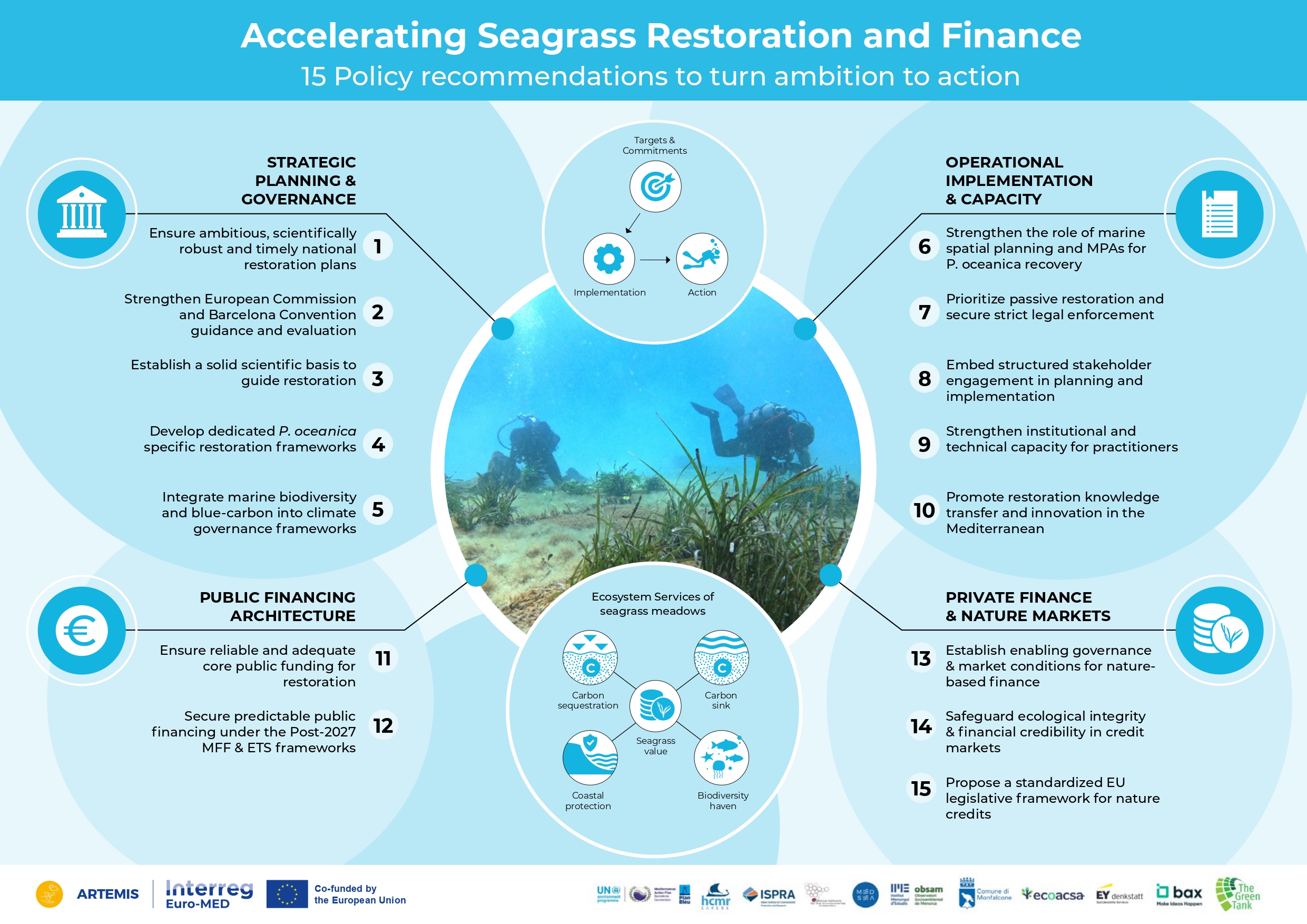
The report titled “Accelerating Seagrass Restoration and Finance” examines the ecological, legal and financial dimensions of restoring one of the Mediterranean's most valuable marine ecosystems, Posidonia meadows, and proposes 15 recommendations to turn policy ambition into action.
Posidonia oceanica meadows provide critical ecosystem services, including biodiversity support, coastal protection and carbon storage. Yet, despite decades of conservation efforts, they continue to decline due to coastal development, anchorage and climate change.
The report comes at a pivotal moment as Member States prepare National Restoration Plans under the EU Nature Restoration Regulation, with first drafts due to the European Commission by September 1st, 2026. As highlighted during the recently organized ARTEMIS policy roundtable “From Meadows to Markets: Advancing Seagrass Restoration and Sustainable Financing”, the report and its recommendation contribute to the ongoing implementation of the European Union Roadmap toward Nature Credits, a new initiative of the European Commission.
Drawing on lessons from ARTEMIS pilot sites in Greece, Italy and Spain, the report identifies key governance and financing gaps that hinder restoration efforts and outlines policy solutions.
While restoration is gaining strategic importance, implementation remains fragmented, with inconsistent permitting, technical standards and monitoring limiting large-scale deployment.
The report highlights that restoring P. oceanica requires long-term investment. While EU and national public funding are the main sources of support, current financing is often misaligned with the long ecological recovery timescales. Even when complemented with donor and private sources, available funding is well below estimated needs.
The report puts forward 15 policy recommendations structured around four priority areas: strengthening governance and strategic planning; improving implementation capacity; securing long-term public funding; and developing credible private financing mechanisms for restoration.
Among its key recommendations, the report calls on Mediterranean countries to develop ambitious and scientifically sound National Restoration Plans under the EU Nature Restoration Regulation, establish dedicated restoration frameworks for Posidonia oceanica, strengthen marine spatial planning and protected areas, and integrate seagrass ecosystems into climate and blue-carbon policies. It also highlights the importance of stakeholder participation, scientific evidence, and institutional capacity in ensuring restoration success.
The report also stresses that public funding must remain the foundation of restoration, particularly in the context of the ongoing negotiations on the EU Multiannual Financial Framework 2028-2034. At the same time, complementary financing mechanisms can mobilise additional resources, if supported by clear governance and robust safeguards.
The ARTEMIS project developed and tested a Posidonia credit, illustrating how private finance could support restoration, provided that strong monitoring, verification and environmental integrity standards are in place.
“While restoration is now firmly on the policy agenda, the governance and financing conditions needed to deliver it at scale are still lacking. The ARTEMIS recommendations provide concrete policy directions to turn ambition into action across EU, national, regional and local levels,” said Ioli Christopoulou, Policy Director and co-founder of The Green Tank.
“The restoration of Posidonia oceanica can no longer rely on isolated projects. Scaling up action across the Mediterranean will require stable financing, coordinated governance, and stronger regional cooperation to share expertise, harmonise approaches, and ensure restoration targets are met on time,” underlined Arnaud Terisse, Biodiversity Programme Officer at Plan Bleu.
Notes:
- The Interreg Euro-MED ARTEMIS project (Accelerating the Restoration of Seagrass Meadows in the Mediterranean Area through Innovative Ecosystem-Service Based Solutions) aims to improve the restoration techniques of Posidonia oceanica meadows, assess the ecosystem services they provide, and create innovative techniques for integrating them into both policy-making and investment decisions. The project has been implemented by ten partners across five European and Mediterranean countries, with Plan Bleu as the project coordinator, from January 2024 through June 2026.
- The report “Accelerating Seagrass Restoration and Finance 15 Policy Recommendations to Turn Ambition into Action” draws on lessons from ARTEMIS pilot sites in Greece (Atzikiari, Bay, in Siteia, Crete), Italy (Capo Testa Punta Falcone in Sardinia, and Panzano Bay in Monfalcone), and Spain (Cala Banca in Menorca), and an in-depth analysis of existing frameworks led by Plan Bleu and The Green Tank, with input from all ARTEMIS partners. It identifies key challenges that continue to hinder restoration efforts and outlines policy solutions. The full report also includes an annex with country chapters for each ARTEMIS pilot country, outlining site-specific findings and recommendations.
- The report findings were presented during the ARTEMIS Final Conference on June 8-10 in Menorca and during the ARTEMIS Online Policy Roundtable “From Meadows to Markets: Advancing Seagrass Restoration and Sustainable Financing” hosted by MEP Dimitris Tsiodras and organized by the Green Tank in the framework of the Interreg Euro-MED ARTEMIS.
- A documentary on the Interreg Euro-MED Artemis has been produced by MEDSEA in collaboration with ARTEMIS partners available here and a docuseries presenting each pilot site has been concluded and is available here.
- The EU Roadmap towards Nature Credits was issued on 7 July 2025. Its implementation by the European Commission is supported by an Expert Group on Nature Credits, to which The Green Tank, an ARTEMIS partner, is a member. For more information: https://green-forum.ec.europa.eu/green-business/nature-credits_en
For further information, media materials or interview requests:
ARTEMIS Interreg Euro-MED Press Office
Giulia Eremita
Tel. +39 348 036 0916 //
Email: This email address is being protected from spambots. You need JavaScript enabled to view it. // This email address is being protected from spambots. You need JavaScript enabled to view it.
Video Documentary
Latest news

After Decades on the Seabed, Ghost Net Removed off Villasimius with GhostNetBusters
120 kg of fishing nets were removed from the seabed, while a further 510 kg of nets and other fishing gear recovered during previous operations were disposed of, together with…

"GhostNetBusters”: Patagonia joins MEDSEA and the Capo Carbonara MPA to free the seabed from ghost nets
Villasimius will host “GhostNetBusters”, an environmental initiative organised by the MEDSEA Foundation in collaboration with the Capo Carbonara Marine Protected Area, with the support of Patagonia

Posidonia oceanica: First Restoration Intervention Launched in Lacco Ameno Bay, Ischia
As part of the Oasi Marina initiative promoted by Beiersdorf and announced last year, MEDSEA Foundation has completed its first Posidonia oceanica restoration intervention in Lacco Ameno Bay, on the island of Ischia. The restoration…

CRESO Project Meets in Nice: MEDSEA Presents a Roadmap from Climate Risk to Coastal Action
The Interreg Marittimo project CRESO gathered its partners in Nice on 5 June 2026 for a full-day meeting dedicated to presenting the first year of work on a cross-border approach…

Wetland4Change, from research to planning: the project’s final meeting in the Camargue
Two days of discussion on wetland-based solutions for carbon sequestration and flood risk reduction. MEDSEA presented the results from the Marceddì–San Giovanni pilot site together with representatives of the Regional…

ARTEMIS, from pilot actions to Mediterranean-scale impact: MEDSEA at the final conference in Menorca
Three days of discussion on the results of the Interreg Euro-MED project dedicated to seagrass meadow restoration. MEDSEA presented the Sardinian pilot site and the communication work that documented two…

Posidonia Restoration: 15 ARTEMIS Recommendations to Support Italy and the Mediterranean in Implementing the Nature Restoration Law
The restoration of Mediterranean seagrass meadows must move from fragmented pilot projects to long-term, large-scale action supported by coherent governance and sustainable financing, according to the new report released by…

Marco Spinelli. The power of storytelling to protect seas
For Marco Spinelli, the sea has always been home. A photographer, documentary filmmaker and explorer of the underwater world, he grew up in Sicily, where he spent his childhood exploring the…

Mona Khalil: A Life Devoted to the Sea, Cut Short by War
The voice of Mona Khalil, guardian of southern Lebanon's sea turtles, has been silenced by bombs. For more than twenty years, Mona dedicated her life to protecting sea turtles on…

El Niño: The planet's irregular heartbeat that could also affect the Mediterranean.
El Niño is one of the most important natural climate phenomena on Earth. Although it originates in the tropical Pacific Ocean, it can influence weather and climate on a global scale…

Virginia Salzedo. Finding Resilience in a Fragile Sea
For those who truly know the sea, it is not only about whales or spectacular encounters with its most iconic inhabitants. This is certainly the case for Virginia Salzedo, an internationally…

Mediterranean Seagrass Restoration Efforts Continue in Greece
Following restoration interventions in Sardinia and Malta, MEDSEA has now completed a new restoration campaign on the Greek island of Arkoudi, working alongside iSea, a Greek environmental organisation dedicated to marine…

Greg Lecoeur: Photographing a Changing Ocean
For Greg Lecoeur, the sea has never been merely a subject to photograph. An explorer, wildlife photographer, and storyteller of the marine world, he has transformed a passion nurtured since…

World Oceans Day 2026: Looking Beneath the Surface
The ocean covers around 70% of the Earth's surface, produces more than half of the oxygen we breathe, and absorbs vast amounts of carbon dioxide and heat, helping to mitigate…

Egidio Trainito: Looking Beyond the Beauty of the Sea
For over fifty years, Egidio Trainito has observed the sea through his lens. A nature photographer, expert in sustainable tourism development, and actively involved in conservation projects within Marine Protected…

ARTEMIS Village: Three Days Dedicated to Posidonia oceanica in Santa Teresa Gallura
From 30 May to 1 June 2026, Piazza della Libertà in Santa Teresa Gallura hosted ARTEMIS Village, an educational event dedicated to the sea and the protection of Posidonia oceanica, held as…
- 1
- 2
- 3
- 4