
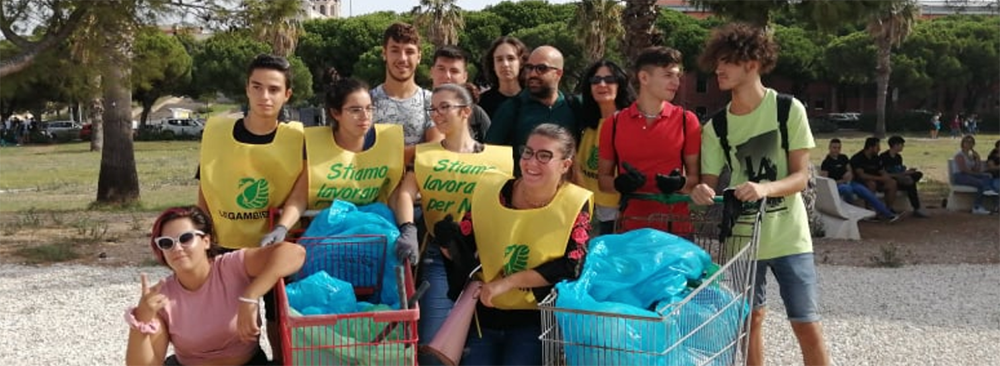
"We are imagining the future", explains Inza Fofana, holding a bag full of rubbish. He left three years ago the Ivory Coast at war and arrived in Italy on a boat, after he crawled up half of the African continent. A guest for months in the Libyan hell. Inza, now eighteen, is one of the many students from the Buccari and Marconi institutes of Cagliari who took part in the "#PlasticFreeGC" initiative, promoted by the general command of the Coast Guard Corps on request of the Ministry of the Environment.
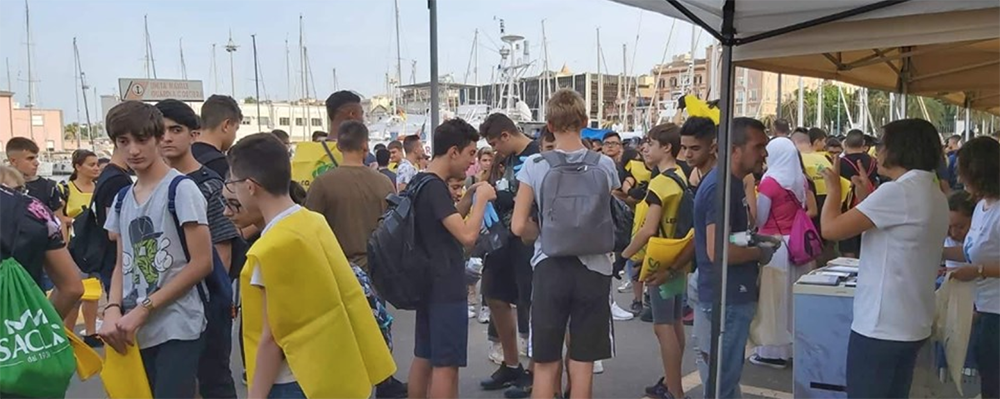
The awareness-raising day on the issues of environmental protection, and in particular on the danger represented by the dispersion of plastics in the marine and coastal ecosystem, began at 9.00 am in Piazza Deffenu with the speech of Davide Minciullo Barbagiovanni, responsible for operations of the Management maritime authority of the Harbor Offices. Among the many organizations that decided to participate, the MEDSEA foundation was also present, happy to illustrate to visitors the various protection strategies implemented through its daily actions. Among them the Maristanis project, focused on the conservation of the wetlands encircling the Oristano gulf.
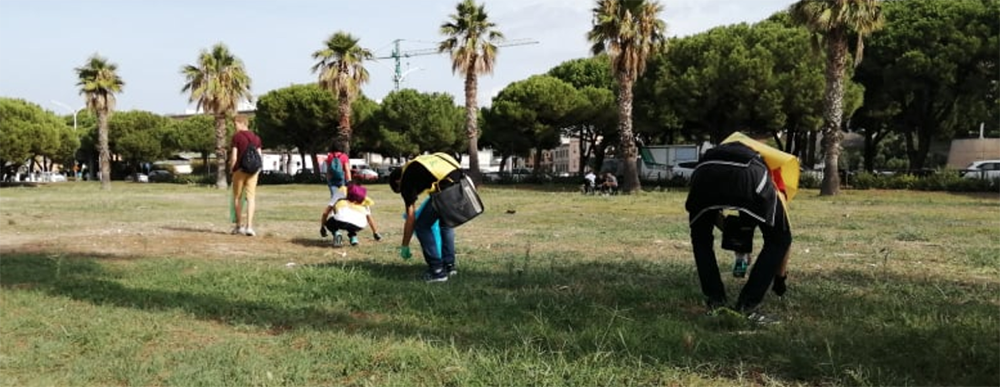
Once the kit for the garbage collection was distributed by Legambiente, the students left the stands lined up in front of the building of the captaincy to head towards the 4th Regia in via dei Calafati and the pine forest of "Su Siccu". "We must abandon the use of plastic and instead adopt that of biodegradable materials", says without hesitation Matteo Pallotta, student of the third class of the Marconi institute. "It is important for teachers to relate to young people with new methods, especially at the beginning of the year", adds Professor Raffaelina Gallo. Around boys and girls continue the collection activity, framing themselves with gloves and bags in the pictures that immediately start to flow in Instagram and Facebook.
"The teaching approach is changing a lot. In the classroom we offer lessons entirely dedicated to the environment. We organize events, we project videos. The pupils respond very well, they are aware of the importance of the topic and feel that they are taking part in a global phenomenon, such as the week for future, as their fellow students in Berlin or New York”, says Professor Sabrina Tripepi. "At school we replaced plastic with biodegradable materials. Water bottles will soon be eliminated, all the teachers and students will be given a bottle to be filled with new dispensers", adds his colleague Giusy Putzu.
In the meantime, the 4th Sub Coast Guard Unit performs on the platform an operational demonstration of intervention, while curious visitors stop in front of the stands to ask for information. “The problem of plastic at sea also derives from the fact that the boats, which must be considered as small floating houses, produce a considerable amount of waste. For this reason they must find proper structures in the port capable to help them in recycling", explains Giorgia De Gioannis, professor of environmental engineering at the University of Cagliari and one of the scientific leaders of the GRRinPort project. "The project promotes action plans for the management of ship-generated waste in port. One of the docks here will be equipped with a column for the suction of black water and bilge water. Shippers will be distributed to the boat owners to collect the vegetable oils accumulated during navigation. This waste will subsequently be poured into special bells. We will soon have water-quality monitoring stations, and we will install natural wool materials capable of biodegrading hydrocarbons".
"It is encouraging to see so much enthusiasm in young boys and girls. This is why we at the Coast Guard also carry out various projects related to environmental protection", says the commander Minciullo Barbagiovanni. “With ARPAS (Regional Agenzcy for Environmental Protection Sardinia) we carry out extensive research on plastics and microplastics, ensuring continuous monitoring
on our coasts and in particular on protected marine areas. We also investigate the spots that EMSA (the European maritime safety agency) detects on the surface thanks to the satellites”.
"The MEDSEA foundation could not miss such an appointment. The message of a plastic-free world begins to assert itself, and we must support it in every way we can” explains Francesca Frau, founding partner of MEDSEA, expert in Mediterranean biodiversity conservation and responsible for the “#PlasticFreeMed” campaign, carried out in collaboration with Parley for the Oceans. The campaign, which began in 2018, includes many initiatives, especially the cleaning of beaches and seabeds in Sardinia and other Mediterranean marine areas. The aim is to make the population aware of the danger represented by plastics, which compose about 90% of the waste collected at sea. Plastic is the main threat to all the organisms that dwell the sea. Not unusual are the recovery interventions of turtles and cetaceans that have ingested plastic fragments or remained trapped in the nets, injuring themselves or finding death. "It is an environmental emergency, and making our voices heard, joining them in shared events like today is a duty", says Frau.
Latest news

Ocean&Climate Village comes to Cagliari for the first time: MEDSEA engages schools and university students
For the first time, the Ocean&Climate Village came to Cagliari, bringing an exhibition dedicated to ocean awareness, the ocean’s role in regulating the climate, and the protection of marine biodiversity…

Il Viaggio delle Balene: Tracce nel Blu expedition concludes after 497 nautical miles of marine biodiversity research around Sardini
The scientific expedition Tracce nel Blu – Route for Biodiversity concluded on Friday, 9 October. It marked the second edition of ** Il Viaggio delle Balene (The Whale Journey)**, a…

Tracce nel Blu 2026: the new Il Viaggio delle Balene mission has set sail
Tracce nel Blu – Route for Biodiversity has set sail: the 2026 scientific expedition of Il Viaggio delle Balene, dedicated to cetacean monitoring, Mediterranean monk seal research through environmental DNA…

MEDCONNECT launches in Limassol: MEDSEA leads two Work Packages and the Italian National Hub
Turning blue innovation into solutions that can be adopted, financed and replicated across the Mediterranean. This is the challenge at the heart of MEDCONNECT, the new Mediterranean Lighthouse of the…

After Decades on the Seabed, Ghost Net Removed off Villasimius with GhostNetBusters
120 kg of fishing nets were removed from the seabed, while a further 510 kg of nets and other fishing gear recovered during previous operations were disposed of, together with…

"GhostNetBusters”: Patagonia joins MEDSEA and the Capo Carbonara MPA to free the seabed from ghost nets
Villasimius will host “GhostNetBusters”, an environmental initiative organised by the MEDSEA Foundation in collaboration with the Capo Carbonara Marine Protected Area, with the support of Patagonia

Posidonia oceanica: First Restoration Intervention Launched in Lacco Ameno Bay, Ischia
As part of the Oasi Marina initiative promoted by Beiersdorf and announced last year, MEDSEA Foundation has completed its first Posidonia oceanica restoration intervention in Lacco Ameno Bay, on the island of Ischia. The restoration…

CRESO Project Meets in Nice: MEDSEA Presents a Roadmap from Climate Risk to Coastal Action
The Interreg Marittimo project CRESO gathered its partners in Nice on 5 June 2026 for a full-day meeting dedicated to presenting the first year of work on a cross-border approach…

Wetland4Change, from research to planning: the project’s final meeting in the Camargue
Two days of discussion on wetland-based solutions for carbon sequestration and flood risk reduction. MEDSEA presented the results from the Marceddì–San Giovanni pilot site together with representatives of the Regional…

ARTEMIS, from pilot actions to Mediterranean-scale impact: MEDSEA at the final conference in Menorca
Three days of discussion on the results of the Interreg Euro-MED project dedicated to seagrass meadow restoration. MEDSEA presented the Sardinian pilot site and the communication work that documented two…

Posidonia Restoration: 15 ARTEMIS Recommendations to Support Italy and the Mediterranean in Implementing the Nature Restoration Law
The restoration of Mediterranean seagrass meadows must move from fragmented pilot projects to long-term, large-scale action supported by coherent governance and sustainable financing, according to the new report released by…

Marco Spinelli. The power of storytelling to protect seas
For Marco Spinelli, the sea has always been home. A photographer, documentary filmmaker and explorer of the underwater world, he grew up in Sicily, where he spent his childhood exploring the…

Mona Khalil: A Life Devoted to the Sea, Cut Short by War
The voice of Mona Khalil, guardian of southern Lebanon's sea turtles, has been silenced by bombs. For more than twenty years, Mona dedicated her life to protecting sea turtles on…

El Niño: The planet's irregular heartbeat that could also affect the Mediterranean.
El Niño is one of the most important natural climate phenomena on Earth. Although it originates in the tropical Pacific Ocean, it can influence weather and climate on a global scale…

Virginia Salzedo. Finding Resilience in a Fragile Sea
For those who truly know the sea, it is not only about whales or spectacular encounters with its most iconic inhabitants. This is certainly the case for Virginia Salzedo, an internationally…

Mediterranean Seagrass Restoration Efforts Continue in Greece
Following restoration interventions in Sardinia and Malta, MEDSEA has now completed a new restoration campaign on the Greek island of Arkoudi, working alongside iSea, a Greek environmental organisation dedicated to marine…
- 1
- 2
- 3
- 4