
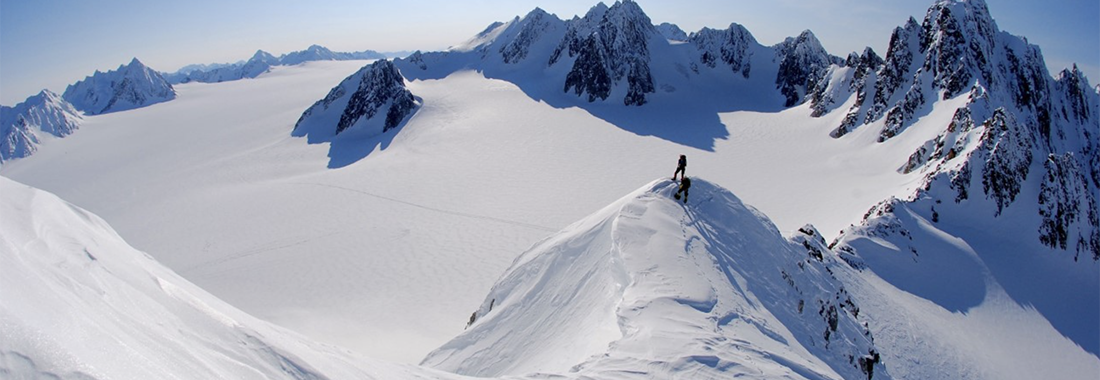
"You perceive yourself as infinitely small, the scenario around is majestic and fragile. You can't but feel responsible, you start thinking insistently on how to protect it". Around Gianluca Casagrande, professor of geography at the European University of Rome, it lays out the exhibition "82 ° 07'Nord- on a sailing boat on the edge of the Pole, following of the airship Italy": the cobalt of the sea is set in a fjord of meager brown, snow-stained hills, or is crossed by surfacing of a flat, vast rock covered with lichens. Giddy white sculptures advance solitarily with their sharp lines, marking the boundary between the open sea and the lands of ice. Always, the tiny figure of Nanuq, the eco-sustainable sailboat that for seven weeks has carried a team of ten scientists to places where ninety years before Umberto Nobile and his crew found glory and tragedy.
The exhibition is hosted in Cagliari by the headquarters of the Banco di Sardegna Foundation, sponsor of the Polarquest 2019 expedition and organizer of the meeting "Research on the state of plastic pollution in the North Pole and the Mediterranean", one of the many moments of the Cagliari FestivalScienza and of the Lab Boat 2019 scientific dissemination project, organized by CRS4. "Polarquest has been a multidisciplinary and innovative experience. In ideal continuity with the expedition of the general Nobile, we have tried to verify the applicability of a more accessible and less impacting scientific research, compatible with citizen science. We have experimented how much knowledge can be gathered with 'poor' means, a fundamental premise if one day we want local populations and tourists to contribute to the knowledge and protection of these extreme and wonderful places", explains Casagrande.
Not only new, in-depth mapping of ravines in the Svalbard islands, but the measurement of cosmic rays, particles coming from the galactic and extra-galactic space: “We are very happy with the results. We were able to collect data at latitudes to which few had arrived. Measures that were missing, in fact. Since there exist particle accelerators, much of the research has moved there, but even the accelerators are unable to recreate cosmic rays with an energy similar to that coming from extragalactic spaces", explains Ombretta Pinazza, researcher of the Institute National Nuclear Physics and Nanuq crew member for four weeks. The small telescope mounted on the sailboat cabin was built by Italian high school students with the collaboration of Swiss and Norwegian peers. The students have not only assembled the technology, but continue to analyze the collected data. "Studying cosmic rays is very important", adds Pinazza. "Some rare particles trigger huge secondary swarms and we still have no idea what kind of source can generate such energies. It's like watching messages from an unknown world”.
During the crossing that touched the outer layers of the polar pack at 82 ° 07’, allowed by extremely favorable weather conditions, the Nanuq reached the point from which ninety years before the radio operator Giuseppe Biagi launched the first SOS after the crash. A celebration, and an occasion to fathom the seabottom in search of the airship’s shell, which could have followed the drift of the famous red tent, inside which the survivors found refuge. The collected data were then passed to Roberto Demontis, researcher of CRS4: "For several months we have analyzed the data with the geographic information system (GIS), crossing them with historical memories. We have tried to identify with precision what was the area of the crash, and the dynamics of subsequent events”.
But even in the rarefied landscapes of the North Pole have been touched by the disastrous results of the furious consumption of the underlying Earth. On the shores touched by the Nanuq, Polarquest's team often found fishing nets, bottles of detergent, chips’ bags. An environmental urgency, that of plastics, which during the meeting was contextualized in the Mediterranean by Giorgio Massaro, expert in environmental sciences of the MEDSEA Foundation. "From 2004 to today there have been many initiatives that at every level, from the European to the local, from the political to the scientific, have tried to study the phenomenon and conceive solutions. Many animal species are killed or contaminated by plastics and microplastics, and the beauty of the coasts is disfigured", says Massaro. "We need to talk about it, spread the message of good practices and become engaged. By now there are many clean-ups to which anyone can participate. In June, the MEDSEA Foundation organized ‘Puliamo la Sella’ in Cagliari, which involved over two hundred citizens and various sports and environmental associations. There are many dormant energies in our society. Another example is that of 'Bars for the Sea', which MEDSEA is pursuing together with the US foundation 'Parley for the Oceans'. Some kiosks of the Poetto beach have decided to abandon the use of disposable plastics. We saved at least a ton of it between the last days of July and early September. Now the kiosks involved in the project are eight”.
Latest news

Tracce nel Blu 2026: the new Il Viaggio delle Balene mission has set sail
Tracce nel Blu – Route for Biodiversity has set sail: the 2026 scientific expedition of Il Viaggio delle Balene, dedicated to cetacean monitoring, Mediterranean monk seal research through environmental DNA…

MEDCONNECT launches in Limassol: MEDSEA leads two Work Packages and the Italian National Hub
Turning blue innovation into solutions that can be adopted, financed and replicated across the Mediterranean. This is the challenge at the heart of MEDCONNECT, the new Mediterranean Lighthouse of the…

After Decades on the Seabed, Ghost Net Removed off Villasimius with GhostNetBusters
120 kg of fishing nets were removed from the seabed, while a further 510 kg of nets and other fishing gear recovered during previous operations were disposed of, together with…

"GhostNetBusters”: Patagonia joins MEDSEA and the Capo Carbonara MPA to free the seabed from ghost nets
Villasimius will host “GhostNetBusters”, an environmental initiative organised by the MEDSEA Foundation in collaboration with the Capo Carbonara Marine Protected Area, with the support of Patagonia

Posidonia oceanica: First Restoration Intervention Launched in Lacco Ameno Bay, Ischia
As part of the Oasi Marina initiative promoted by Beiersdorf and announced last year, MEDSEA Foundation has completed its first Posidonia oceanica restoration intervention in Lacco Ameno Bay, on the island of Ischia. The restoration…

CRESO Project Meets in Nice: MEDSEA Presents a Roadmap from Climate Risk to Coastal Action
The Interreg Marittimo project CRESO gathered its partners in Nice on 5 June 2026 for a full-day meeting dedicated to presenting the first year of work on a cross-border approach…

Wetland4Change, from research to planning: the project’s final meeting in the Camargue
Two days of discussion on wetland-based solutions for carbon sequestration and flood risk reduction. MEDSEA presented the results from the Marceddì–San Giovanni pilot site together with representatives of the Regional…

ARTEMIS, from pilot actions to Mediterranean-scale impact: MEDSEA at the final conference in Menorca
Three days of discussion on the results of the Interreg Euro-MED project dedicated to seagrass meadow restoration. MEDSEA presented the Sardinian pilot site and the communication work that documented two…

Posidonia Restoration: 15 ARTEMIS Recommendations to Support Italy and the Mediterranean in Implementing the Nature Restoration Law
The restoration of Mediterranean seagrass meadows must move from fragmented pilot projects to long-term, large-scale action supported by coherent governance and sustainable financing, according to the new report released by…

Marco Spinelli. The power of storytelling to protect seas
For Marco Spinelli, the sea has always been home. A photographer, documentary filmmaker and explorer of the underwater world, he grew up in Sicily, where he spent his childhood exploring the…

Mona Khalil: A Life Devoted to the Sea, Cut Short by War
The voice of Mona Khalil, guardian of southern Lebanon's sea turtles, has been silenced by bombs. For more than twenty years, Mona dedicated her life to protecting sea turtles on…

El Niño: The planet's irregular heartbeat that could also affect the Mediterranean.
El Niño is one of the most important natural climate phenomena on Earth. Although it originates in the tropical Pacific Ocean, it can influence weather and climate on a global scale…

Virginia Salzedo. Finding Resilience in a Fragile Sea
For those who truly know the sea, it is not only about whales or spectacular encounters with its most iconic inhabitants. This is certainly the case for Virginia Salzedo, an internationally…

Mediterranean Seagrass Restoration Efforts Continue in Greece
Following restoration interventions in Sardinia and Malta, MEDSEA has now completed a new restoration campaign on the Greek island of Arkoudi, working alongside iSea, a Greek environmental organisation dedicated to marine…

Greg Lecoeur: Photographing a Changing Ocean
For Greg Lecoeur, the sea has never been merely a subject to photograph. An explorer, wildlife photographer, and storyteller of the marine world, he has transformed a passion nurtured since…

World Oceans Day 2026: Looking Beneath the Surface
The ocean covers around 70% of the Earth's surface, produces more than half of the oxygen we breathe, and absorbs vast amounts of carbon dioxide and heat, helping to mitigate…
- 1
- 2
- 3
- 4