
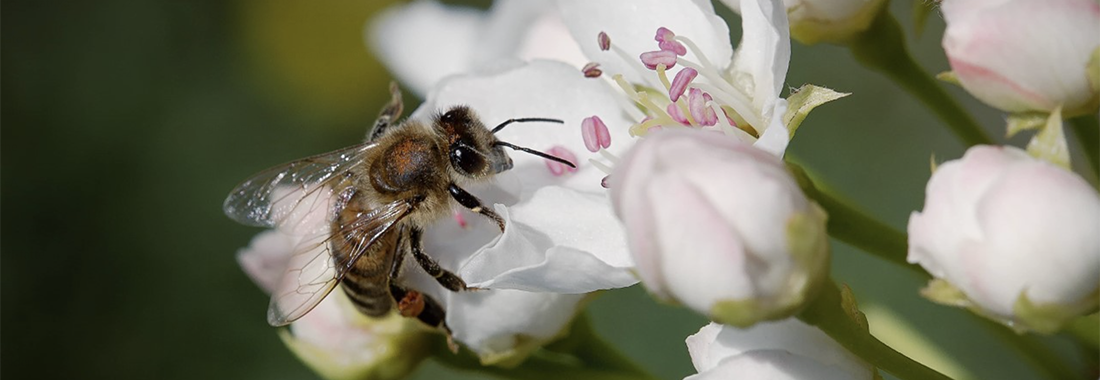
Bees, what a passion. There are many writers, scientists or poets who have chosen bees as the object of speculation. Albert Einstein had issued the warning: "If bees disappeared from the face of the earth, man would have only four years left to live". Mario Rigoni Stern, a writer deeply attached to his land, the Asiago plateau, had underlined its social vocation: "Bees are 'together' and not individuals. Outside the community can not live". The poet Neruda celebrated with a signifier that seems a step of dance the tireless activity of the bees, "pure workers, ogival workers, fine, glittering proletarians". An interest which, also on the part of the media, grows, unfortunately, in a way directly proportional to the risk of disappearance of the bees and, in general, of all the pollinating insects.
Bees at risk of extinction: an enormous damage. Recently, in 2016, the Intergovernmental Science-Policy Platform on Biodiversity and Ecosystem Services (IPBES) published its first report dedicated to the decline in biodiversity of pollinating insects. IPBES estimates suggest that at least one in ten insects is threatened with extinction, creating unimaginable economic damage. The loss of pollinators puts $577 billion of agricultural production at risk, while soil degradation has reduced productivity by 23%. The European Food Safety Authority's website writes: "Beekeeping is an ancient tradition. Honeybees have been bred in Europe for several millennia. Bees are fundamental to the environment, as they promote biodiversity by playing the essential role of pollination for many crops and wild plants. They contribute directly to human wealth and well-being through the production of honey and other food and feed products such as pollen, food processing wax, propolis in food technology and royal jelly as a dietary supplement and food ingredient. According to estimates by the Food and Agriculture Organisation of the United Nations (FAO), of the 100 crop species that provide 90 % of the world's food, 71 are pollinated by bees. Most crops in the EU are dependent on insect pollination. Moreover, beyond the fundamental value of pollination for the conservation of biodiversity, its global annual monetary value has been estimated at hundreds of billions of euros. According to the journal Science, since the 1980s, in the United Kingdom alone, 52% of the wild species in the bees' family have been lost, i.e. the apoids, which account for 80% of the total species. Another survey, conducted by researchers at the University of Berkley, reveals the damage that such a loss causes: the study established that the existence of natural habitats for pollinating insects, within 1-2 km of farms, increases agricultural production in a decisive way. According to the research team's measurements, at least 90% of the monitored crops have been pollinated by wild insects.
The initiative to save bees and pollinators. As is often the case, civil society sounds the alarm bell when the abyss opens and could be a point of no return. The European Commission has therefore decided to register a European citizens' initiative entitled "Save the bees! Protecting biodiversity and improving habitats for insects in Europe". The organisers' policy platform focuses on several issues: making the promotion of biodiversity an overall objective of the Common Agricultural Policy, reducing the use of pesticides, promoting structural diversity in agricultural landscapes and cutting the use of fertilisers in Natura 2000 areas. Signatures will be collected from 27 May: there will be time to collect one million statements of support from at least seven different Member States. If the result is achieved, the Commission will have to react within three months, deciding whether or not to comply with the request, with a reasoned opinion. City bees have chosen MEDSEA. It may sound strange, but insects are disappearing more and more in the countryside. Small urban habitats in densely populated cities sometimes have the potential to become islands for the conservation of biodiversity. The city can be a place where areas can be created for the protection of the nourishing species of the so-called useful insects and the botanical species that are increasingly less widespread. Sometimes bees, mysterious and fascinating insects, choose their home with unfathomable determination and it is a small miracle to find a hive under the window of the MEDSEA Foundation. The urban centre thus becomes a refuge for many animal and plant species that can find a less hostile environment for their survival and the bees, in particular, remain less exposed to all those chemical agents used in agriculture. MEDSEA loves her bees!
Latest news

Ocean&Climate Village comes to Cagliari for the first time: MEDSEA engages schools and university students
For the first time, the Ocean&Climate Village came to Cagliari, bringing an exhibition dedicated to ocean awareness, the ocean’s role in regulating the climate, and the protection of marine biodiversity…

Il Viaggio delle Balene: Tracce nel Blu expedition concludes after 497 nautical miles of marine biodiversity research around Sardini
The scientific expedition Tracce nel Blu – Route for Biodiversity concluded on Friday, 9 October. It marked the second edition of ** Il Viaggio delle Balene (The Whale Journey)**, a…

Tracce nel Blu 2026: the new Il Viaggio delle Balene mission has set sail
Tracce nel Blu – Route for Biodiversity has set sail: the 2026 scientific expedition of Il Viaggio delle Balene, dedicated to cetacean monitoring, Mediterranean monk seal research through environmental DNA…

MEDCONNECT launches in Limassol: MEDSEA leads two Work Packages and the Italian National Hub
Turning blue innovation into solutions that can be adopted, financed and replicated across the Mediterranean. This is the challenge at the heart of MEDCONNECT, the new Mediterranean Lighthouse of the…

After Decades on the Seabed, Ghost Net Removed off Villasimius with GhostNetBusters
120 kg of fishing nets were removed from the seabed, while a further 510 kg of nets and other fishing gear recovered during previous operations were disposed of, together with…

"GhostNetBusters”: Patagonia joins MEDSEA and the Capo Carbonara MPA to free the seabed from ghost nets
Villasimius will host “GhostNetBusters”, an environmental initiative organised by the MEDSEA Foundation in collaboration with the Capo Carbonara Marine Protected Area, with the support of Patagonia

Posidonia oceanica: First Restoration Intervention Launched in Lacco Ameno Bay, Ischia
As part of the Oasi Marina initiative promoted by Beiersdorf and announced last year, MEDSEA Foundation has completed its first Posidonia oceanica restoration intervention in Lacco Ameno Bay, on the island of Ischia. The restoration…

CRESO Project Meets in Nice: MEDSEA Presents a Roadmap from Climate Risk to Coastal Action
The Interreg Marittimo project CRESO gathered its partners in Nice on 5 June 2026 for a full-day meeting dedicated to presenting the first year of work on a cross-border approach…

Wetland4Change, from research to planning: the project’s final meeting in the Camargue
Two days of discussion on wetland-based solutions for carbon sequestration and flood risk reduction. MEDSEA presented the results from the Marceddì–San Giovanni pilot site together with representatives of the Regional…

ARTEMIS, from pilot actions to Mediterranean-scale impact: MEDSEA at the final conference in Menorca
Three days of discussion on the results of the Interreg Euro-MED project dedicated to seagrass meadow restoration. MEDSEA presented the Sardinian pilot site and the communication work that documented two…

Posidonia Restoration: 15 ARTEMIS Recommendations to Support Italy and the Mediterranean in Implementing the Nature Restoration Law
The restoration of Mediterranean seagrass meadows must move from fragmented pilot projects to long-term, large-scale action supported by coherent governance and sustainable financing, according to the new report released by…

Marco Spinelli. The power of storytelling to protect seas
For Marco Spinelli, the sea has always been home. A photographer, documentary filmmaker and explorer of the underwater world, he grew up in Sicily, where he spent his childhood exploring the…

Mona Khalil: A Life Devoted to the Sea, Cut Short by War
The voice of Mona Khalil, guardian of southern Lebanon's sea turtles, has been silenced by bombs. For more than twenty years, Mona dedicated her life to protecting sea turtles on…

El Niño: The planet's irregular heartbeat that could also affect the Mediterranean.
El Niño is one of the most important natural climate phenomena on Earth. Although it originates in the tropical Pacific Ocean, it can influence weather and climate on a global scale…

Virginia Salzedo. Finding Resilience in a Fragile Sea
For those who truly know the sea, it is not only about whales or spectacular encounters with its most iconic inhabitants. This is certainly the case for Virginia Salzedo, an internationally…

Mediterranean Seagrass Restoration Efforts Continue in Greece
Following restoration interventions in Sardinia and Malta, MEDSEA has now completed a new restoration campaign on the Greek island of Arkoudi, working alongside iSea, a Greek environmental organisation dedicated to marine…
- 1
- 2
- 3
- 4