
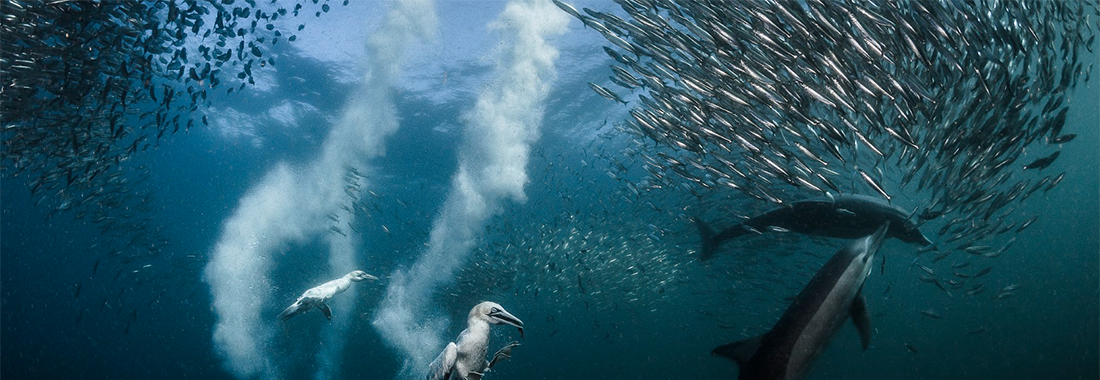
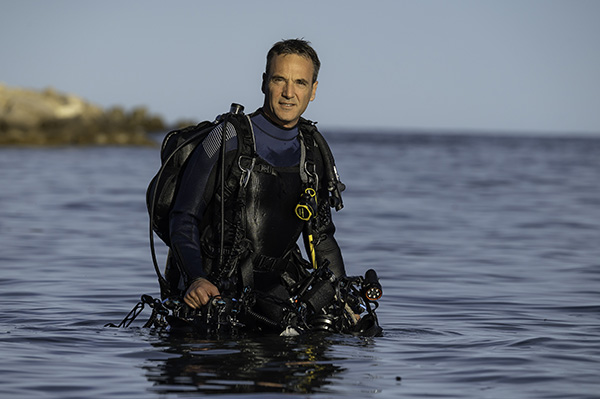
For Greg Lecoeur, the sea has never been merely a subject to photograph. An explorer, wildlife photographer, and storyteller of the marine world, he has transformed a passion nurtured since childhood into a life mission: documenting the extraordinary beauty of the ocean while revealing its growing fragility.
From the Mediterranean Sea to some of the world's most spectacular marine migrations, his work portrays ecosystems in constant transformation, reminding us just how delicate the balance that sustains life in the ocean truly is.
The Ocean as a Life Choice
Lecoeur's relationship with the sea began in childhood, when he spent his free time sailing and diving in the Mediterranean. But it was a specific encounter, around twenty-five years ago, that marked a decisive turning point.
“A truly life-changing moment was an encounter off the coast of Nice 25 years ago with a large group of pilot whales. This encounter was a timeless experience. About thirty of them came to rest at the front of the boat, and we drifted for several dozen minutes. The encounter was magical, and it was then that I decided to buy my first camera to share my adventures.”
That experience sparked his desire to purchase his first camera and capture the extraordinary moments he experienced at sea. However, the decision to dedicate his life entirely to the ocean came later, in 2011, as the result of a realization that had slowly matured over time. It was not about escaping from something, but about consciously embracing what he considered essential.
“I had built a successful life on paper, and yet I felt disconnected from what truly moved me. Each time I returned to the ocean, something within me shifted: a feeling of harmony, of purpose. Eventually, the contrast became too powerful to ignore.”
From Wonder to Witness
At the beginning of his career, as Lecoeur explains, “my first images were driven by fascination and aesthetics.”
Over time, however, his perspective evolved. Exploration, close encounters with marine wildlife, and direct observation of environmental change led him to understand just how vulnerable ocean ecosystems can be.
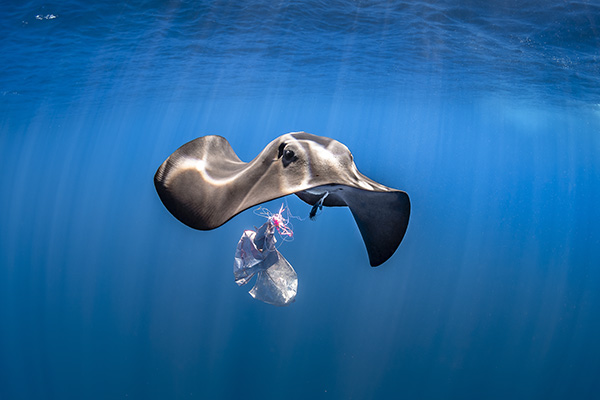
“The more I explored, the more I understood the fragility of the ocean. Encounters became more intimate, sometimes more profound. Seeing pollution, degraded ecosystems, silent reefs, or the absence of species where they once thrived forces you to take a step back.”
He continues:
“A turning point came when I realized that beauty alone wasn't enough. My work had to be meaningful, to bear witness.”
Today, Lecoeur sees the ocean not only as a source of inspiration, but as a living system that requires attention, respect, and protection.
Throughout his work, the relationship between humans and the ocean frequently emerges as a central theme—one that, in his view, needs to be rebuilt.
“For me, this tension is not simply about conflict, but about balance. We are all part of the same living system, yet we often behave as if we were separate from it. Rebuilding that connection is, I believe, one of the most essential steps toward protecting the ocean.”
National Geographic’s Nature Photographer of the Year 2016
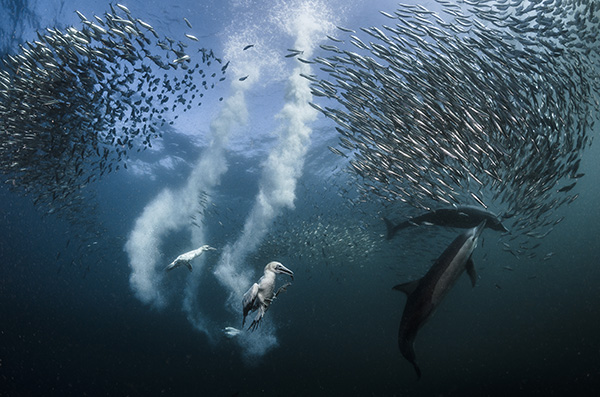
Lecoeur has extensively documented the Sardine Run, one of the most spectacular marine migrations on the planet. Observing and studying this event over the years, he has noticed changes that are not always immediately visible.
His iconic photograph depicting a sardine migration earned him the title of National Geographic Nature Photographer of the Year in 2016.
“One of the most striking changes is not always what we see, but what we no longer see. The sardine migration has become more fragile, less predictable. The balance seems more precarious than before. Sardine migration depends on many climatic parameters, and overfishing has reduced population stocks. As a food source, many species depend on sardines for their survival. Fewer sardines, fewer predators, fewer large schools, the gradual erosion of abundance, and the loss of biodiversity.”
Beyond Aesthetics: The Role of Photography in Conservation
“Wonder is the starting point—it captures attention and stirs emotion. But true impact lies in what follows.”
Lecoeur is convinced that photography can contribute to conservation only when it moves beyond aesthetics. On its own, photography cannot change the world, but it can influence how we perceive reality. And perceptions, in turn, shape decisions.
At the same time, he expresses concern about the overwhelming abundance of images that characterizes the age of social media.
“Spectacular scenes of marine life are becoming commonplace, and species once difficult to encounter now appear easily accessible. This abundance can create the illusion of a thriving ocean.”
For Lecoeur, a photograph should retain its value as an authentic testimony—a fragment of reality capable of telling not only a story of beauty, but also the context in which that beauty exists.
Marine Protected Areas and the 30x30 Challenge
Looking at the global goal of protecting 30% of the world's oceans by 2030, Lecoeur has no doubts about the crucial role of Marine Protected Areas.
“Where they are managed effectively, we are already seeing the difference: ecosystems are regenerating, biodiversity is increasing, and resilience is returning.”
Protecting a significant portion of the ocean does not mean restricting human activity; it means ensuring that marine ecosystems can continue to support life—including our own. Yet too often, we act only when the consequences affect us directly.
This is precisely why, according to the author’s words, images continue to play an essential role: helping us see what is changing before it disappears forever.
Latest news

After Decades on the Seabed, Ghost Net Removed off Villasimius with GhostNetBusters
120 kg of fishing nets were removed from the seabed, while a further 510 kg of nets and other fishing gear recovered during previous operations were disposed of, together with…

"GhostNetBusters”: Patagonia joins MEDSEA and the Capo Carbonara MPA to free the seabed from ghost nets
Villasimius will host “GhostNetBusters”, an environmental initiative organised by the MEDSEA Foundation in collaboration with the Capo Carbonara Marine Protected Area, with the support of Patagonia

Posidonia oceanica: First Restoration Intervention Launched in Lacco Ameno Bay, Ischia
As part of the Oasi Marina initiative promoted by Beiersdorf and announced last year, MEDSEA Foundation has completed its first Posidonia oceanica restoration intervention in Lacco Ameno Bay, on the island of Ischia. The restoration…

CRESO Project Meets in Nice: MEDSEA Presents a Roadmap from Climate Risk to Coastal Action
The Interreg Marittimo project CRESO gathered its partners in Nice on 5 June 2026 for a full-day meeting dedicated to presenting the first year of work on a cross-border approach…

Wetland4Change, from research to planning: the project’s final meeting in the Camargue
Two days of discussion on wetland-based solutions for carbon sequestration and flood risk reduction. MEDSEA presented the results from the Marceddì–San Giovanni pilot site together with representatives of the Regional…

ARTEMIS, from pilot actions to Mediterranean-scale impact: MEDSEA at the final conference in Menorca
Three days of discussion on the results of the Interreg Euro-MED project dedicated to seagrass meadow restoration. MEDSEA presented the Sardinian pilot site and the communication work that documented two…

Posidonia Restoration: 15 ARTEMIS Recommendations to Support Italy and the Mediterranean in Implementing the Nature Restoration Law
The restoration of Mediterranean seagrass meadows must move from fragmented pilot projects to long-term, large-scale action supported by coherent governance and sustainable financing, according to the new report released by…

Marco Spinelli. The power of storytelling to protect seas
For Marco Spinelli, the sea has always been home. A photographer, documentary filmmaker and explorer of the underwater world, he grew up in Sicily, where he spent his childhood exploring the…

Mona Khalil: A Life Devoted to the Sea, Cut Short by War
The voice of Mona Khalil, guardian of southern Lebanon's sea turtles, has been silenced by bombs. For more than twenty years, Mona dedicated her life to protecting sea turtles on…

El Niño: The planet's irregular heartbeat that could also affect the Mediterranean.
El Niño is one of the most important natural climate phenomena on Earth. Although it originates in the tropical Pacific Ocean, it can influence weather and climate on a global scale…

Virginia Salzedo. Finding Resilience in a Fragile Sea
For those who truly know the sea, it is not only about whales or spectacular encounters with its most iconic inhabitants. This is certainly the case for Virginia Salzedo, an internationally…

Mediterranean Seagrass Restoration Efforts Continue in Greece
Following restoration interventions in Sardinia and Malta, MEDSEA has now completed a new restoration campaign on the Greek island of Arkoudi, working alongside iSea, a Greek environmental organisation dedicated to marine…

Greg Lecoeur: Photographing a Changing Ocean
For Greg Lecoeur, the sea has never been merely a subject to photograph. An explorer, wildlife photographer, and storyteller of the marine world, he has transformed a passion nurtured since…

World Oceans Day 2026: Looking Beneath the Surface
The ocean covers around 70% of the Earth's surface, produces more than half of the oxygen we breathe, and absorbs vast amounts of carbon dioxide and heat, helping to mitigate…

Egidio Trainito: Looking Beyond the Beauty of the Sea
For over fifty years, Egidio Trainito has observed the sea through his lens. A nature photographer, expert in sustainable tourism development, and actively involved in conservation projects within Marine Protected…

ARTEMIS Village: Three Days Dedicated to Posidonia oceanica in Santa Teresa Gallura
From 30 May to 1 June 2026, Piazza della Libertà in Santa Teresa Gallura hosted ARTEMIS Village, an educational event dedicated to the sea and the protection of Posidonia oceanica, held as…
- 1
- 2
- 3
- 4