
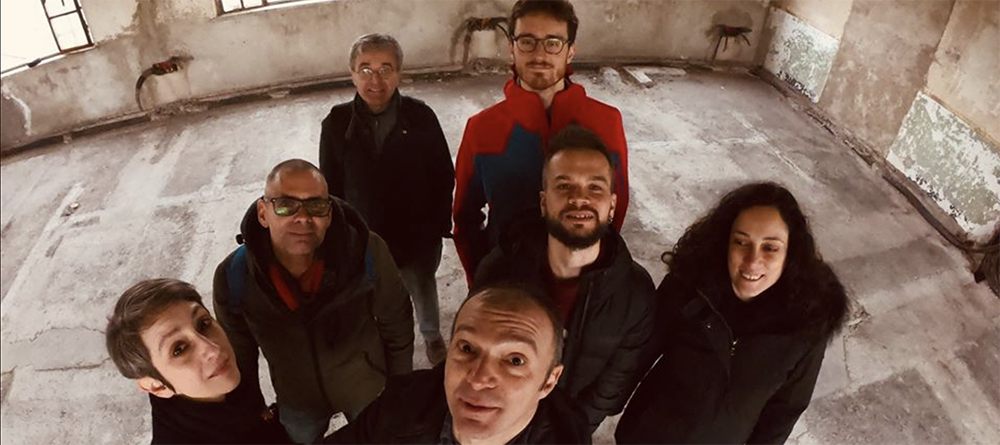

“Earth sciences system have gone wasted. We knew everything and we did nothing”. The climatologist Luca Mercalli opens with a provocation his interview. He is the first to intervene in the Sunday afternoon chat of Radio Station, entitled "Amare aperto" and conducted by Maurizio Guagnetti. During the live streaming on Facebook, the guests’ faces are listed on the video conference platform, embedded in turn in the bare room of the former central Milan electrical substation. Much more than a broadcaster, Radio Station was born as a community space that with programs, courses, events and tourism promotion services gravitates around the themes of territory, culture and sustainability. This week water and the oceans are the chosen subjects.
Out of ignorance or willfulness our increasingly detailed science has been shut in a drawer by politics and economics, continues Mercalli. Can the virus impose a new attitude? “The tiger mosquito hosts four types of diseases. If the climate changes, mosquitoes move, and diseases reach areas where they didn't exist before. Soon I expect a great floating island of face masks in the ocean". Pollution acidifies the infinite masses of water, warms them up by inducing tropical species to populate temperate seas such as our Mediterranean, increases the volume of water and melts the glaciers, condemning, by the end of the century, the coastal cities of the globe to submersions.
Mercalli agrees with Daniela Ducato, honored with the Order of Merit for Labor and owner of Edizero, a Sardinian company that has long been involved in the design and construction of sustainable materials: there are many tools made available by institutions, at all levels, for the development in the use of green materials. But more than a symphony they seem many disjointed violins, a cacophonic contradiction. "Labeling is needed to describe the product and the virtuous practices that has generated it. If there are valid alternatives, we must simply get rid of the harmful products. Plastic is neither good nor bad, it depends on how you use it, how you dispose of it", says the climatologist.
Among the many sustainable materials created by Edizero, Ducato tells the online listeners about the "oil-eating barriers", born from the collaboration with the University of Cagliari. The barriers are oil-absorbers used in boats or in ports, during normal navigation or in case of disastrous spills. "It is contradictory - says Ducato - that the oil absorbers usually used are made of polyester, the very same material which then turns into microplastic". Edizero's oil-absorbers, composed of animal and vegetable fibers, create a natural habitat that petrochemical bacteria then colonize. Here, thanks to the ideal conditions of humidity and hydration, they can reproduce even for a year while the hydrocarbons break down. In the meantime the material is consumed and consumption biodegrades the oil. Technology has favored the collaboration between Edizero and the MEDSEA foundation. Absorbent banners have been laid out along the docks of the Marceddì marina, one of the most important and representative places of the Maristanis project, born for the protection and sustainable development of the wetlands of the Oristano.
“Coastal wetlands are the most important ecosystems we have if we want to try to reduce the effects of climate change. One hectare of wetlands is caable to accumulate hundreds of tons of carbon dioxide" explains Alessio Satta, environmental engineer and president of MEDSEA. “The Mediterranean is in pretty bad conditions. We are choking it, it is the most polluted sea on the globe. As predicted long time ago soon it will contain more plastic than fish".
"Not all is lost, someone has collected the lessons left by Earth Sciences", comments Daniela Faggion, co-host of the streaming. Enrico Tettamanzi and his family intervene from the waters facing the Bahamas coasts. The pandemic prevents them from disembarking, and in the sailboat with which they cross the oceans in an endless voyage, they had to create a strict routine, especially for the children: “For them the extraordinary life of continuous travel becomes normal, that's how we teach them love and knowledge of the sea. Sometimes we feel responsible, especially during ocean crossings, which creates some tensions among us. But they are already one thing only with the tides, the winds and the marine animals".
Sergio Caramel, one of the ten candidates to become the best Italian sailor of 2020, intervenes from Padua, where he studies engineering. With a team born at the university he is building a bio-boat. “If conditions will allow it, we would like to participate in the competition organized on Lake Garda by Foiling Week for boats built with recyclable materials. It will be a mot capable of flying over water”. Slow down, respect, reduce and routine are according to Caramel the five rules to be applied to a sustainable life at sea. In an afternoon dedicated to the sea good stories must be present. Alberto Coretti and Floriana Cavallo created and became editors of "Sirene Journal", a splendid magazine that recounts any type of "osmosis" between man and water. Needless to say, Sirene Journal is printed on algae paper. "Weed algae, certainly not the posidonia so important for our seas", says Coretti.
Latest news

Ocean&Climate Village comes to Cagliari for the first time: MEDSEA engages schools and university students
For the first time, the Ocean&Climate Village came to Cagliari, bringing an exhibition dedicated to ocean awareness, the ocean’s role in regulating the climate, and the protection of marine biodiversity…

Il Viaggio delle Balene: Tracce nel Blu expedition concludes after 497 nautical miles of marine biodiversity research around Sardini
The scientific expedition Tracce nel Blu – Route for Biodiversity concluded on Friday, 9 October. It marked the second edition of ** Il Viaggio delle Balene (The Whale Journey)**, a…

Tracce nel Blu 2026: the new Il Viaggio delle Balene mission has set sail
Tracce nel Blu – Route for Biodiversity has set sail: the 2026 scientific expedition of Il Viaggio delle Balene, dedicated to cetacean monitoring, Mediterranean monk seal research through environmental DNA…

MEDCONNECT launches in Limassol: MEDSEA leads two Work Packages and the Italian National Hub
Turning blue innovation into solutions that can be adopted, financed and replicated across the Mediterranean. This is the challenge at the heart of MEDCONNECT, the new Mediterranean Lighthouse of the…

After Decades on the Seabed, Ghost Net Removed off Villasimius with GhostNetBusters
120 kg of fishing nets were removed from the seabed, while a further 510 kg of nets and other fishing gear recovered during previous operations were disposed of, together with…

"GhostNetBusters”: Patagonia joins MEDSEA and the Capo Carbonara MPA to free the seabed from ghost nets
Villasimius will host “GhostNetBusters”, an environmental initiative organised by the MEDSEA Foundation in collaboration with the Capo Carbonara Marine Protected Area, with the support of Patagonia

Posidonia oceanica: First Restoration Intervention Launched in Lacco Ameno Bay, Ischia
As part of the Oasi Marina initiative promoted by Beiersdorf and announced last year, MEDSEA Foundation has completed its first Posidonia oceanica restoration intervention in Lacco Ameno Bay, on the island of Ischia. The restoration…

CRESO Project Meets in Nice: MEDSEA Presents a Roadmap from Climate Risk to Coastal Action
The Interreg Marittimo project CRESO gathered its partners in Nice on 5 June 2026 for a full-day meeting dedicated to presenting the first year of work on a cross-border approach…

Wetland4Change, from research to planning: the project’s final meeting in the Camargue
Two days of discussion on wetland-based solutions for carbon sequestration and flood risk reduction. MEDSEA presented the results from the Marceddì–San Giovanni pilot site together with representatives of the Regional…

ARTEMIS, from pilot actions to Mediterranean-scale impact: MEDSEA at the final conference in Menorca
Three days of discussion on the results of the Interreg Euro-MED project dedicated to seagrass meadow restoration. MEDSEA presented the Sardinian pilot site and the communication work that documented two…

Posidonia Restoration: 15 ARTEMIS Recommendations to Support Italy and the Mediterranean in Implementing the Nature Restoration Law
The restoration of Mediterranean seagrass meadows must move from fragmented pilot projects to long-term, large-scale action supported by coherent governance and sustainable financing, according to the new report released by…

Marco Spinelli. The power of storytelling to protect seas
For Marco Spinelli, the sea has always been home. A photographer, documentary filmmaker and explorer of the underwater world, he grew up in Sicily, where he spent his childhood exploring the…

Mona Khalil: A Life Devoted to the Sea, Cut Short by War
The voice of Mona Khalil, guardian of southern Lebanon's sea turtles, has been silenced by bombs. For more than twenty years, Mona dedicated her life to protecting sea turtles on…

El Niño: The planet's irregular heartbeat that could also affect the Mediterranean.
El Niño is one of the most important natural climate phenomena on Earth. Although it originates in the tropical Pacific Ocean, it can influence weather and climate on a global scale…

Virginia Salzedo. Finding Resilience in a Fragile Sea
For those who truly know the sea, it is not only about whales or spectacular encounters with its most iconic inhabitants. This is certainly the case for Virginia Salzedo, an internationally…

Mediterranean Seagrass Restoration Efforts Continue in Greece
Following restoration interventions in Sardinia and Malta, MEDSEA has now completed a new restoration campaign on the Greek island of Arkoudi, working alongside iSea, a Greek environmental organisation dedicated to marine…
- 1
- 2
- 3
- 4