
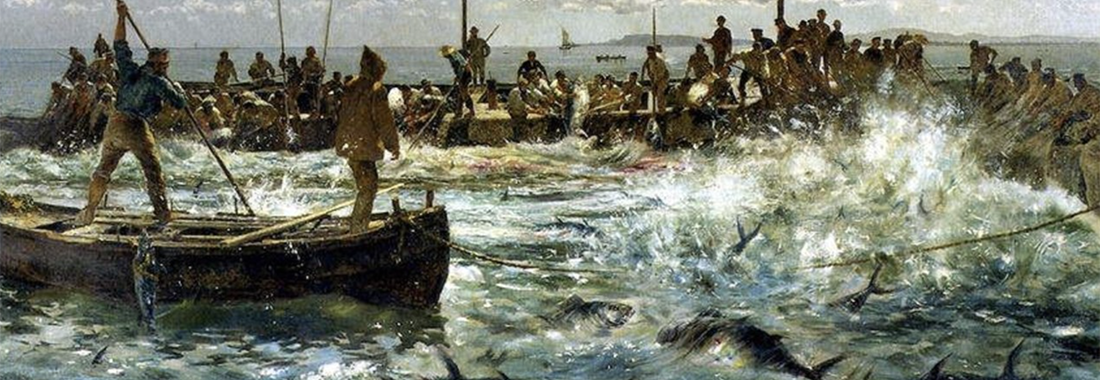
Only last year, the ministerial fishing quotas for the bluefin tuna were fixed, from 2018 to 2020. These quotas are also increasing for Sardinia, thanks to the improvement of fish stocks in the Mediterranean. For 2018, the catch quota (TAC) allocated to Italy by the European Union, according to the directives of the International Commission for the Conservation of Atlantic Tuna, is 3894 tons, which will continue to grow until 2020 (4308 tons in 2019 and 4756 tons in 2020), confirming the same percentage (about 8%) to fixed tuna traps. The Isola Piana, Portoscuso and Porto Paglia tuna fisheries will be able to fish 328 tonnes of bluefin tuna, while the largest share will always be allocated to the purse seine system (2886 tonnes), followed by longlines (527 tons) and, to a lesser extent, recreational and sport fishing (18 tons).
In the debate, always thorny, on the delicate balance between the needs of work and those of the exploited nature, the same entrepreneurs of the Tonnare Sarde had expressed concern about the general increase in the fishing quota, which would lead to a fall in the price of tuna. For those who emphasise the survival of tuna populations at global level, only the reasons for concern change. Tuna is under threat and there is a risk that it will not be able to withstand the pressure of industrialised fishing, which has come from years of mismanagement and overfishing, as in the case of Mediterranean bluefin tuna. This situation has been made even more serious by the system of tuna fed and fattened on sea farms. On the occasion of the World Tuna Day of 2 May, the anniversary established by the General Assembly of the United Nations, the reflection is therefore directed to emphasize the need for sustainable management of its fishing. To date, more than 80 states are practicing tuna fishing and its scope, as already mentioned, continues to grow. The first product to guide the production of canned fish is canned tuna, a market that in Italy has a value of about 1.3 billion euros (2018), with a national production of 74,000 tons and a consumption of 153,251 tons or about 2.5 kg per capita, for a sector that has about 1,500 employees. The other product that makes the demand (and therefore the supply) on the market is the sashimi/sushi. The differences are significant as regards the species used, the quality requirements and the production systems. In the canning market, light meat species - in particular skipjack tuna and yellowfin tuna - are dominant, while in the sushi and sashimi market, bluefin tuna or other bluefin tuna species such as bigeye tuna are preferred. Bigeye tuna is at the top of the preferences for the sushi and sashimi market, most of which is imported into Japan. In order not to jeopardise the future of tuna, a number of projects have been launched in recent years: specific protection and certification initiatives, aimed at conserving and protecting the marine ecosystem and biodiversity, defending the balance between resources and fishing activity, ensuring natural renewal, avoiding overfishing, illegal and incidental fishing. But the road is still long and full of obstacles, especially if only the needs of a short-sighted market are the driving force.
Latest news

Ocean&Climate Village comes to Cagliari for the first time: MEDSEA engages schools and university students
For the first time, the Ocean&Climate Village came to Cagliari, bringing an exhibition dedicated to ocean awareness, the ocean’s role in regulating the climate, and the protection of marine biodiversity…

Il Viaggio delle Balene: Tracce nel Blu expedition concludes after 497 nautical miles of marine biodiversity research around Sardini
The scientific expedition Tracce nel Blu – Route for Biodiversity concluded on Friday, 9 October. It marked the second edition of ** Il Viaggio delle Balene (The Whale Journey)**, a…

Tracce nel Blu 2026: the new Il Viaggio delle Balene mission has set sail
Tracce nel Blu – Route for Biodiversity has set sail: the 2026 scientific expedition of Il Viaggio delle Balene, dedicated to cetacean monitoring, Mediterranean monk seal research through environmental DNA…

MEDCONNECT launches in Limassol: MEDSEA leads two Work Packages and the Italian National Hub
Turning blue innovation into solutions that can be adopted, financed and replicated across the Mediterranean. This is the challenge at the heart of MEDCONNECT, the new Mediterranean Lighthouse of the…

After Decades on the Seabed, Ghost Net Removed off Villasimius with GhostNetBusters
120 kg of fishing nets were removed from the seabed, while a further 510 kg of nets and other fishing gear recovered during previous operations were disposed of, together with…

"GhostNetBusters”: Patagonia joins MEDSEA and the Capo Carbonara MPA to free the seabed from ghost nets
Villasimius will host “GhostNetBusters”, an environmental initiative organised by the MEDSEA Foundation in collaboration with the Capo Carbonara Marine Protected Area, with the support of Patagonia

Posidonia oceanica: First Restoration Intervention Launched in Lacco Ameno Bay, Ischia
As part of the Oasi Marina initiative promoted by Beiersdorf and announced last year, MEDSEA Foundation has completed its first Posidonia oceanica restoration intervention in Lacco Ameno Bay, on the island of Ischia. The restoration…

CRESO Project Meets in Nice: MEDSEA Presents a Roadmap from Climate Risk to Coastal Action
The Interreg Marittimo project CRESO gathered its partners in Nice on 5 June 2026 for a full-day meeting dedicated to presenting the first year of work on a cross-border approach…

Wetland4Change, from research to planning: the project’s final meeting in the Camargue
Two days of discussion on wetland-based solutions for carbon sequestration and flood risk reduction. MEDSEA presented the results from the Marceddì–San Giovanni pilot site together with representatives of the Regional…

ARTEMIS, from pilot actions to Mediterranean-scale impact: MEDSEA at the final conference in Menorca
Three days of discussion on the results of the Interreg Euro-MED project dedicated to seagrass meadow restoration. MEDSEA presented the Sardinian pilot site and the communication work that documented two…

Posidonia Restoration: 15 ARTEMIS Recommendations to Support Italy and the Mediterranean in Implementing the Nature Restoration Law
The restoration of Mediterranean seagrass meadows must move from fragmented pilot projects to long-term, large-scale action supported by coherent governance and sustainable financing, according to the new report released by…

Marco Spinelli. The power of storytelling to protect seas
For Marco Spinelli, the sea has always been home. A photographer, documentary filmmaker and explorer of the underwater world, he grew up in Sicily, where he spent his childhood exploring the…

Mona Khalil: A Life Devoted to the Sea, Cut Short by War
The voice of Mona Khalil, guardian of southern Lebanon's sea turtles, has been silenced by bombs. For more than twenty years, Mona dedicated her life to protecting sea turtles on…

El Niño: The planet's irregular heartbeat that could also affect the Mediterranean.
El Niño is one of the most important natural climate phenomena on Earth. Although it originates in the tropical Pacific Ocean, it can influence weather and climate on a global scale…

Virginia Salzedo. Finding Resilience in a Fragile Sea
For those who truly know the sea, it is not only about whales or spectacular encounters with its most iconic inhabitants. This is certainly the case for Virginia Salzedo, an internationally…

Mediterranean Seagrass Restoration Efforts Continue in Greece
Following restoration interventions in Sardinia and Malta, MEDSEA has now completed a new restoration campaign on the Greek island of Arkoudi, working alongside iSea, a Greek environmental organisation dedicated to marine…
- 1
- 2
- 3
- 4