

Economic development and environmental protection can and must find a balance. This was once again confirmed by the Annual Conference of Italian Association of Environmental and Resource Economists (IAERE), hosted in Cagliari, Sardinia, by the Department of Political and Social Sciences on 21 and 22 April. "The economy of environment is still a little-known discipline, but it becomes crucial in a historical moment like this, in which more than anything else a synthesis between the demands of nature and the tension towards development is required" explains Vania Statzu, vice- MEDSEA president and member of IAERE.
Over half of the world's GDP derives from economic activities related to the environment: fishing, agriculture, tourism and construction, just to name a few. The need to rebuild harmony is also expressed by the European Union's 2030 Directive on Biodiversity, which opens its analysis with clear economic data. Without a healthy nature, economy is destined to stop.
Carlo Carraro, rector Emeritus and professor at the Ca 'Foscari University of Venice, member of the IPCC and one of the leading experts on climate change in Italy, renewed in his lectio the call to interpret the ecological transition also as an economic and social step forward. The two souls of the transition cannot be separated, for the outcome would be an unsustainable failure. As shown by the latest data from the IPCC, the Earth risks seeing its average temperature rise by more than 3 degrees in a hundred years: a catastrophe for all forms of life. "We must mobilize society, including anyone we can in the process," Carraro affirmed with conviction.
The two-day Cagliari event, which MEDSEA actively contributed to organize, was also the setting for the first MED-IAERE conference, the first public exchange and sharing event attended by the environmental economists from the North and the South of the Mediterranean, who discussed a common vision and how to support the ecological transition. The MED-IAERE event also saw a round table open to Euro-Mediterranean cooperation programs.
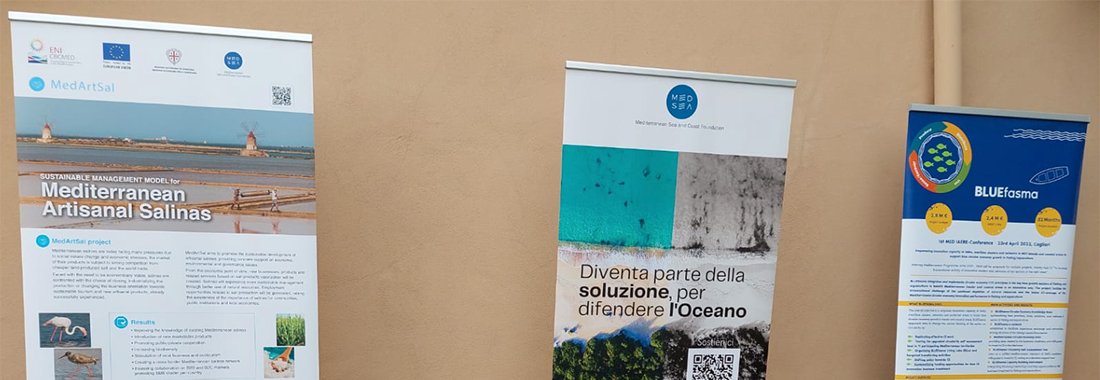
MEDSEA took part in its poster-section describing two projects, "MedArtSal" and "BLUEfasma", committed to encouraging the sustainable revitalization of artisanal salt pans and the circular economy in the fishing and aquaculture sectors. “Many of the visitors were impressed by the two souls of MEDSEA”, says Vania Statzu. "While in BLUEfasma, where we were external experts of the International Marine Center of Torregrande, we carried out research, in MedArtSal we acted concretely in the implementation of a new model of recovery and relaunch of an ancient profession, in a sustainable key. An academic nature capable of delving into the concreteness of reality. Indeed, two rare characteristics in an institution that participates in European projects and has already been included in two Horizon (in addition to two ENI CBC MED, an Interreg MED and an Interreg PO Maritime Italy-France): this amazed the many who came to ask about the two projects and the MEDSEA Foundation”.
From this point of view, the prospects born from the MED-IAERE conference are even more stimulating. The organizations that make it up have mutually committed to create a permanent appointment that can become a reference point for the economy of the environment, even outside the academy. A group capable not only of converging in projects, but of becoming a point of reference for policies regarding the future of the Euro-Mediterranean area.
Latest news

Ocean&Climate Village comes to Cagliari for the first time: MEDSEA engages schools and university students
For the first time, the Ocean&Climate Village came to Cagliari, bringing an exhibition dedicated to ocean awareness, the ocean’s role in regulating the climate, and the protection of marine biodiversity…

Il Viaggio delle Balene: Tracce nel Blu expedition concludes after 497 nautical miles of marine biodiversity research around Sardini
The scientific expedition Tracce nel Blu – Route for Biodiversity concluded on Friday, 9 October. It marked the second edition of ** Il Viaggio delle Balene (The Whale Journey)**, a…

Tracce nel Blu 2026: the new Il Viaggio delle Balene mission has set sail
Tracce nel Blu – Route for Biodiversity has set sail: the 2026 scientific expedition of Il Viaggio delle Balene, dedicated to cetacean monitoring, Mediterranean monk seal research through environmental DNA…

MEDCONNECT launches in Limassol: MEDSEA leads two Work Packages and the Italian National Hub
Turning blue innovation into solutions that can be adopted, financed and replicated across the Mediterranean. This is the challenge at the heart of MEDCONNECT, the new Mediterranean Lighthouse of the…

After Decades on the Seabed, Ghost Net Removed off Villasimius with GhostNetBusters
120 kg of fishing nets were removed from the seabed, while a further 510 kg of nets and other fishing gear recovered during previous operations were disposed of, together with…

"GhostNetBusters”: Patagonia joins MEDSEA and the Capo Carbonara MPA to free the seabed from ghost nets
Villasimius will host “GhostNetBusters”, an environmental initiative organised by the MEDSEA Foundation in collaboration with the Capo Carbonara Marine Protected Area, with the support of Patagonia

Posidonia oceanica: First Restoration Intervention Launched in Lacco Ameno Bay, Ischia
As part of the Oasi Marina initiative promoted by Beiersdorf and announced last year, MEDSEA Foundation has completed its first Posidonia oceanica restoration intervention in Lacco Ameno Bay, on the island of Ischia. The restoration…

CRESO Project Meets in Nice: MEDSEA Presents a Roadmap from Climate Risk to Coastal Action
The Interreg Marittimo project CRESO gathered its partners in Nice on 5 June 2026 for a full-day meeting dedicated to presenting the first year of work on a cross-border approach…

Wetland4Change, from research to planning: the project’s final meeting in the Camargue
Two days of discussion on wetland-based solutions for carbon sequestration and flood risk reduction. MEDSEA presented the results from the Marceddì–San Giovanni pilot site together with representatives of the Regional…

ARTEMIS, from pilot actions to Mediterranean-scale impact: MEDSEA at the final conference in Menorca
Three days of discussion on the results of the Interreg Euro-MED project dedicated to seagrass meadow restoration. MEDSEA presented the Sardinian pilot site and the communication work that documented two…

Posidonia Restoration: 15 ARTEMIS Recommendations to Support Italy and the Mediterranean in Implementing the Nature Restoration Law
The restoration of Mediterranean seagrass meadows must move from fragmented pilot projects to long-term, large-scale action supported by coherent governance and sustainable financing, according to the new report released by…

Marco Spinelli. The power of storytelling to protect seas
For Marco Spinelli, the sea has always been home. A photographer, documentary filmmaker and explorer of the underwater world, he grew up in Sicily, where he spent his childhood exploring the…

Mona Khalil: A Life Devoted to the Sea, Cut Short by War
The voice of Mona Khalil, guardian of southern Lebanon's sea turtles, has been silenced by bombs. For more than twenty years, Mona dedicated her life to protecting sea turtles on…

El Niño: The planet's irregular heartbeat that could also affect the Mediterranean.
El Niño is one of the most important natural climate phenomena on Earth. Although it originates in the tropical Pacific Ocean, it can influence weather and climate on a global scale…

Virginia Salzedo. Finding Resilience in a Fragile Sea
For those who truly know the sea, it is not only about whales or spectacular encounters with its most iconic inhabitants. This is certainly the case for Virginia Salzedo, an internationally…

Mediterranean Seagrass Restoration Efforts Continue in Greece
Following restoration interventions in Sardinia and Malta, MEDSEA has now completed a new restoration campaign on the Greek island of Arkoudi, working alongside iSea, a Greek environmental organisation dedicated to marine…
- 1
- 2
- 3
- 4